
Software can be copied fast. A feature can be cloned. A landing page can be scraped. A contractor can walk away with code. A former employee can remember how your system works. A competitor can launch something that looks very close to yours.
That sounds scary. But here is the good news.
You do not need a giant legal team to start protecting your software intellectual property. You need a clear plan. You need clean ownership. You need smart contracts. You need basic security. And you need to know which parts of your startup should be protected by copyright, trade secrets, patents, trademarks, or plain old access control.
This article is written for startup founders, especially software founders in Los Angeles and California. It is not legal advice. You should work with a qualified IP lawyer before making big legal moves. But it will give you a strong, practical map.
Why Software IP Matters So Much for Los Angeles and california Founders
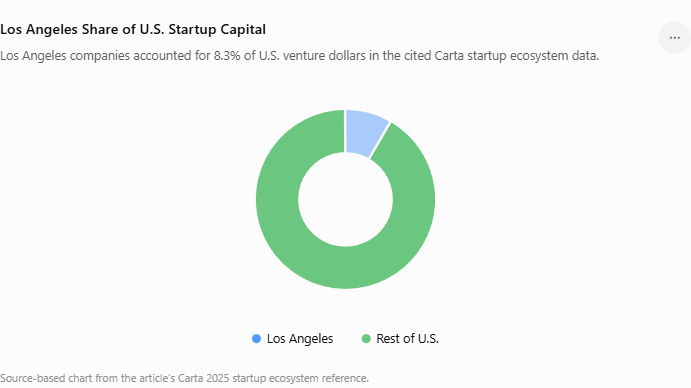
Los Angeles is not just an entertainment city anymore. It is a serious startup market. Carta’s 2025 startup ecosystem data placed Los Angeles third among U.S. startup ecosystems by share of capital raised, with LA companies accounting for 8.3% of U.S. venture dollars in that dataset.
That matters because money attracts speed. Speed attracts copycats. And copycats love software because software can be studied, rebuilt, and shipped faster than many physical products.
LA founders also sit at the meeting point of many industries: media, gaming, e-commerce, health tech, fintech, sports, logistics, creator tools, AI, aerospace, and entertainment tech. In these markets, your product is often not just code. It may include data, workflows, creative content, user experience, brand trust, models, integrations, partner lists, and internal playbooks.
That is why “protecting software IP” is not one task. It is a system.
The Simple Truth: You Cannot Protect “An Idea”
Many first-time founders say, “I want to protect my app idea.”
That is the wrong target.
A raw idea is usually not enough. “An AI tool for real estate agents” is not something you can lock down by itself. “A marketplace for local tutors” is not yours just because you thought of it. “A social app for music fans” is too broad.
What you can protect is the real work behind the idea.
Your code. Your product design. Your database structure. Your training data. Your workflows. Your brand name. Your logo. Your technical method. Your internal roadmap. Your customer list. Your pricing logic. Your documentation. Your content. Your secret process for making the system work better than others.
That shift is important. Stop asking, “How do I protect my idea?” Start asking, “What exact assets make this company hard to copy?”
What Counts as Software Intellectual Property?
Software IP is bigger than code.
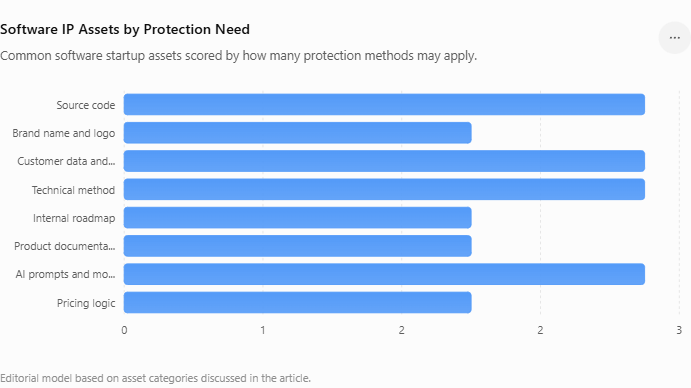
Your startup may own many valuable assets, even if you have not filed a single patent or trademark yet. A useful software IP map usually includes your source code, object code, product architecture, APIs, internal tools, data models, user interface designs, test scripts, technical documentation, training datasets, prompts, model weights, product names, logos, domain names, customer research, pricing systems, sales scripts, and private product roadmaps.
The law protects different parts in different ways.
Copyright can protect original code and some screen displays. Trade secret law can protect confidential information that has value because it is not generally known, as long as you take reasonable steps to keep it secret. Patents can protect some technical inventions, but software patents need careful drafting. Trademarks protect names, logos, and other signs that help customers know the source of your product. The USPTO explains that patents, trademarks, copyrights, and trade secrets are separate forms of IP, and each protects a different kind of business asset.
A strong founder does not try to force everything into one bucket. A strong founder builds layers.
The Five-Layer Software IP Shield
Think of your software IP plan like a building with five locks.
The first lock is ownership. You need to make sure the company actually owns what it thinks it owns.
The second lock is confidentiality. You need to stop secret information from becoming public.
The third lock is registration. You may need copyrights, trademarks, and sometimes patents.
The fourth lock is contracts. You need written rules with founders, workers, contractors, customers, vendors, and partners.
The fifth lock is technical control. You need to manage who can access your code, data, and systems.
Most IP disasters happen because one of these locks was missing.
A founder files a copyright registration but never got a code assignment from the freelancer. A founder makes everyone sign an NDA but leaves the GitHub repo open to old contractors. A founder files a patent after showing the invention publicly for too long. A founder spends $80,000 on branding but never checks if the name can be used. A founder raises seed funding and then learns the first engineer built core code on top of a risky open-source license.
These problems are avoidable.
Start With Ownership Before You Start With Protection
The biggest IP mistake is not theft. It is unclear ownership.
Before asking how to stop others from copying your software, ask a simpler question: does your startup actually own the software?
That sounds obvious. It often is not.
Founder Ownership
If two founders build the first version before forming a company, the company may not automatically own that work. The same issue can happen with pitch decks, mockups, early designs, domain names, prototypes, and private repositories.
The fix is not complicated, but it must be written down. Each founder should assign relevant pre-company work to the company. The founder agreement should also say that future work created for the company belongs to the company.
This is not just about lawsuits. It is about fundraising. Investors often ask whether all founders have assigned IP to the company. If the answer is messy, the deal slows down.
Employee Work
For employees, U.S. copyright law has a “work made for hire” rule. In general, when an employee creates work within the scope of employment, the employer is treated as the author and owner. The U.S. Copyright Office explains that a work made for hire can exist when an employee creates the work as part of regular duties, or when a certain type of commissioned work is created under an express written agreement.
Still, software startups should not rely only on default rules. Employment agreements should include confidentiality, invention assignment, return-of-property terms, and clear language saying work created for the company belongs to the company.
This is even more important in California because employee mobility is protected strongly. California’s Attorney General has reminded workers that non-compete and no-poach agreements that restrict worker mobility are generally unlawful in California.
So do not build your IP plan around stopping people from working elsewhere. Build it around owning the work, protecting secrets, and controlling access.
Contractor Work
Contractors are where many startups get burned.
A freelancer, agency, offshore team, UX designer, or fractional CTO may not automatically give you full ownership just because you paid them. Payment and ownership are not the same thing.
Your contractor agreement should clearly say that the company owns the deliverables, source code, designs, documentation, inventions, and related rights. It should include a present assignment of rights, not just a promise to assign later. It should also include confidentiality terms, open-source rules, AI-tool rules, and a promise that the contractor did not copy someone else’s work.
Do not wait until the contractor relationship ends. Get the agreement signed before work starts.
Build an IP Inventory Before You File Anything
A founder can waste a lot of money protecting the wrong thing.
Before filing patents or trademarks, create a simple IP inventory. This is a living document that says what the company owns, where it is stored, who created it, who can access it, and how it is protected.
Start with your core product. Write down the main modules, code repositories, databases, models, designs, docs, brand assets, content assets, and customer-facing names. Then add who created each item. Was it a founder, employee, contractor, agency, advisor, open-source project, AI tool, or vendor?
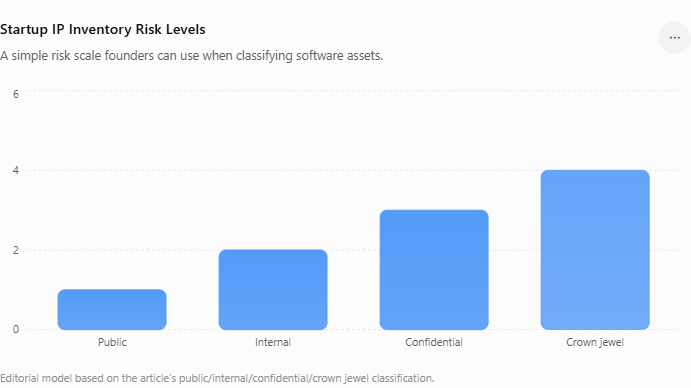
Next, mark each item by risk.
Some assets are public. Your website copy, product screenshots, blog content, and public documentation may fall here. Some assets are private but not highly sensitive. Internal designs and ordinary planning docs may fall here. Some assets are crown jewels. Source code, model weights, customer data, pricing algorithms, security architecture, unreleased features, and key workflows often sit in this group.
The goal is simple: know what matters before something goes wrong.
Copyright: The First Protection Layer for Code
Copyright is often the easiest starting point for software.
In simple terms, copyright can protect original code as a creative work. It does not protect the broad idea behind the software. It does not stop someone from building a competing product with their own code. But it can help if someone copies your actual code, documentation, or other protected expression.
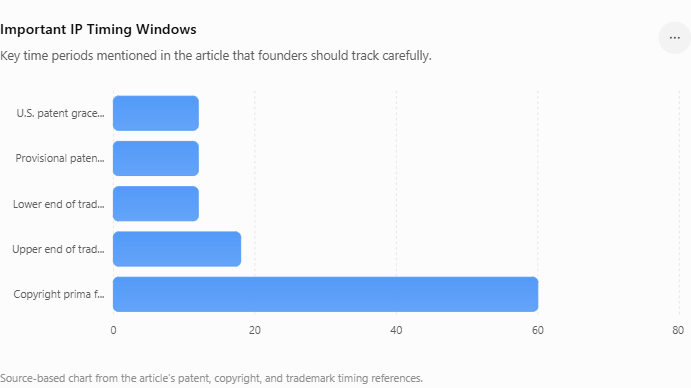
For startups, copyright registration is often worth considering for major software releases. The U.S. Copyright Office says registration creates a public record, and registered works may be eligible for statutory damages and attorney’s fees in successful litigation. Registration within five years of publication can also serve as prima facie evidence in court.
For software, the Copyright Office has specific deposit rules. For a new computer program, the electronic copy is generally the first 25 and last 25 pages, or equivalent units, of source code. If the program contains trade secrets, the Office allows certain redacted or limited deposit options, including submitting the first 10 and last 10 pages of source code or blocking out trade secret material in certain cases.
That means a founder does not always have to expose the whole codebase to register software. But this should be handled carefully.
When Copyright Registration Makes Sense
Copyright registration may make sense when you have a stable version of the core product, when you are selling to enterprise customers, when your code is commercially important, when you suspect copying risk, or when you are preparing for funding or acquisition.
Do not register every tiny update. That can become expensive and messy. Instead, talk to counsel about a release-based plan. For example, you might register the first commercial version, then major versions that include meaningful new code.
What Copyright Will Not Do
Copyright will not protect your business model. It will not protect your general feature list. It will not stop a competitor from looking at your product and writing different code to solve the same problem.
This is why copyright is useful but not enough.
Trade Secrets: The Best Shield for What You Do Not Want to Reveal
Trade secrets are powerful because they do not require registration. They can last as long as the information stays secret and valuable.
A trade secret can include source code, formulas, methods, processes, customer lists, pricing information, technical designs, marketing plans, and business strategies if the information has economic value from being secret and the owner takes reasonable steps to protect it. Cornell’s Legal Information Institute explains that trade secret protection depends on secrecy and reasonable protective steps, and that protection may be lost if the information becomes generally known or if reasonable measures are not used.
California law also focuses on whether the information has independent economic value from not being generally known and whether the owner made reasonable efforts to keep it secret.
That phrase, “reasonable efforts,” is where founders need to pay attention.
You cannot call everything secret after the fact. You need to act like it is secret before trouble starts.
What Should Be Treated as a Trade Secret?
For a software startup, trade secret treatment may fit your ranking logic, fraud detection rules, recommendation system, data cleaning process, model training method, prompt library, internal evaluation set, pricing engine, deployment architecture, security process, conversion data, sales scripts, customer notes, and unreleased roadmap.
Some code may be both copyright-protected and trade secret-protected. But the moment you publish it or give it away without controls, trade secret protection can weaken or disappear.
How to Protect Trade Secrets in Real Life
A practical trade secret program does not need to be fancy. It needs to be real.
Give access only to people who need it. Use private repositories. Turn on multi-factor authentication. Remove access when someone leaves. Mark sensitive documents as confidential. Keep key technical docs in controlled folders. Use NDAs when sharing private information. Train employees on what cannot be shared. Keep logs. Avoid sending crown-jewel details in casual Slack channels, public AI tools, or email threads with outside parties.
This matters because under the federal Defend Trade Secrets Act, a trade secret owner may bring a civil action when a trade secret related to a product or service used in interstate or foreign commerce is misappropriated. Remedies can include injunctions, damages, and in some cases attorney’s fees or exemplary damages.
But in a fight, the question will not just be, “Was this valuable?” It will also be, “Did you actually protect it?”
Patents: Useful, Expensive, and Not for Every Software Startup
Patents can be valuable, but they are not magic.
A software patent does not protect “an app idea.” It may protect a specific technical invention if it meets patent rules. For software and AI inventions, the key is often showing a real technical improvement, not just using a computer to do a normal business task. The USPTO’s 2025 memo on software-related subject matter eligibility discusses the need to consider whether claims are directed to an improvement in computer function or another technical field, instead of merely using a computer as a tool to apply an abstract idea.
That is why founders should not ask, “Can I patent my app?” A better question is, “Did we invent a new technical method that makes the system work better?”
When a Software Patent May Be Worth Exploring
A patent may be worth exploring if your startup has a technical breakthrough that competitors will want to copy, if the invention is hard to keep secret once the product is used, if the invention can be detected in a competitor’s product, if your industry values patent portfolios, or if patents matter for enterprise deals, fundraising, licensing, or acquisition.
AI, cybersecurity, data compression, computer vision, robotics, developer tools, fintech infrastructure, medical software, and hardware-connected software may have stronger patent reasons than a simple workflow app.
File Before You Talk Too Much
Public disclosure can damage patent rights.
The USPTO says a provisional application can be filed up to 12 months after an inventor’s public disclosure under the U.S. grace period, but warns that such disclosure may block patenting in foreign countries. It also explains that a provisional application does not become a patent by itself and is automatically abandoned after 12 months unless proper follow-up steps are taken.
This is important for LA founders who pitch often. Demo days, investor decks, public launches, conferences, Product Hunt posts, YouTube demos, and customer pilots can all create disclosure issues.
The safer path is to talk to a patent lawyer before public launch if the technical invention matters.
Provisional Patent Applications
A provisional patent application can be a useful early step. It can secure a filing date, allow “patent pending” language, and give the founder up to 12 months to decide whether to file a nonprovisional application. But it must describe the invention well enough to support later claims.
A weak provisional can create false comfort. A cheap filing that barely explains the system may not help when you need it.
Trademarks: Protect the Name Customers Remember
Your code may power the product, but your brand carries the trust.
A trademark can protect the name, logo, slogan, or other sign that tells customers your product comes from you. For software startups, this may include the company name, app name, product name, logo, sub-brand, AI assistant name, and sometimes even a distinctive icon or sound.
The USPTO says you can file an intent-to-use trademark application if you have not used the mark in commerce yet but have a good-faith plan to use it. An ITU filing can give you an earlier application filing date than a possible competitor, though you must later show real use before registration.
That is useful for startups building in private before launch.
Do the Search Before You Fall in Love With the Name
Many founders pick a name, buy the domain, design the logo, print the deck, build the website, and only then search trademarks.
That is backwards.
The USPTO’s trademark toolkit says the federal registration process typically takes 12 to 18 months and recommends a clearance search before filing. It also notes that a mark may be refused if it is likely to cause confusion with another mark or if it is descriptive or generic.
Before launch, search the USPTO database, domain names, app stores, social handles, Google results, state business records, and major competitor names. For serious brands, use a trademark lawyer.
A name change after launch can be painful. A name change after funding can be expensive. A name change after customers know you can be brutal.
Contracts Are Not Boring. They Are IP Infrastructure.
Many founders think contracts are paperwork.
They are not. For a software company, contracts are part of the product’s defense system.
Your contracts should answer simple questions. Who owns the code? Who can use it? Who can copy it? Who can reverse engineer it? Who can train models on it? Who can see the source code? What happens when the relationship ends? What happens if someone uses open-source code improperly? What happens if a customer uploads data? What happens if a vendor builds something based on your confidential information?
Founder Agreements
Founder agreements should cover equity, roles, vesting, IP assignment, confidentiality, departure, and dispute handling. The IP section should assign company-related inventions and work product to the company.
Employee Agreements
Employee agreements should include confidentiality and invention assignment language. In California, be careful with overbroad restrictions. Do not try to sneak in non-compete language that conflicts with California law. Focus on ownership, confidentiality, and protection of company property.
Contractor Agreements
Contractor agreements should be stronger than most founders think.
They should cover assignment of all deliverables, confidentiality, moral rights waivers where allowed, open-source limits, AI tool limits, no use of stolen code, no reuse of your confidential information for other clients, cooperation with future IP filings, and return or deletion of materials at the end.
Customer Agreements
Your SaaS terms should say customers get a limited right to use the software, not ownership of it. They should restrict copying, reverse engineering, scraping, resale, unauthorized benchmarking, and misuse. They should also define who owns customer data, usage data, feedback, and product improvements.
Be careful with customer feedback. Many enterprise customers send product ideas. Your agreement should say you can use feedback to improve the product without owing the customer ownership or payment, while still protecting their confidential information.
Vendor Agreements
Vendors can create IP risk. A dev shop, analytics vendor, AI vendor, cloud consultant, security tester, or design agency may touch sensitive assets.
Vendor contracts should limit data use, require confidentiality, restrict subcontractors, define security duties, and state who owns improvements.
Open Source Can Help You Move Fast, But Track It
Modern software is built with open-source packages. That is normal. It is also risky if unmanaged.
Open-source does not mean “no rules.” The Open Source Initiative explains that open-source licenses allow software to be freely used, modified, and shared, but those rights come through license terms.
Some licenses are permissive. Some have stronger sharing duties. Some may create problems if used inside commercial software without review. The risk depends on the license, how the code is used, whether you modify it, whether you distribute software, and whether your product is SaaS, mobile, on-prem, embedded, or API-based.
GitHub’s license compliance guidance explains that tracking dependency licenses and enforcing policy can reduce legal and operational risk by catching nonconforming dependencies before changes are merged.
Build a Simple Open-Source Policy
Do not tell engineers, “Never use open source.” That is not realistic.
Instead, create a small approval flow. Permissive licenses may be allowed by default. Strong copyleft licenses may need legal review. Unknown licenses should be blocked until checked. Copied code from Stack Overflow, random GitHub gists, or AI outputs should be treated with care.
Keep a software bill of materials, or SBOM, so you know what components are inside your product. This helps with security, enterprise sales, and diligence.
Technical Controls Are IP Protection
A surprising amount of IP protection is not legal. It is operational.
If every intern can access every repository, if old contractors still have admin rights, if secrets are stored in plain text, if employees use shared accounts, or if code is copied to personal devices, your legal documents will not save you as much as you think.
NIST’s Secure Software Development Framework recommends storing source code and configuration-as-code in repositories, restricting access based on the nature of the code, using version control to track changes with individual accountability, and using commit signing.
That is not just security advice. It is IP advice.
What Good Control Looks Like
Use role-based access. Give people the least access they need. Require multi-factor authentication. Use company-owned accounts. Ban shared logins. Protect production secrets. Review repo access monthly. Remove access the same day someone leaves. Log important downloads. Require code review before merge. Keep customer data separate from dev environments. Use private package registries where needed.
For very sensitive code, limit cloning. For key models or datasets, restrict export. For internal docs, separate “everyone can read” from “only core team can read.”
Good IP protection is boring on purpose. Boring systems prevent dramatic problems.
AI Tools Create New IP Questions
AI coding tools can help a startup move fast. They can also create messy ownership, confidentiality, and compliance issues.
The U.S. Copyright Office’s AI report addresses the copyrightability of works created using generative AI, and the Office has made clear that AI-related copyright questions depend heavily on human authorship and the role of AI in the final work.
For patents, the USPTO’s 2025 revised AI inventorship guidance says the same legal standard for inventorship applies whether or not AI was used, and that no separate standard is created for AI-assisted inventions.
For founders, the practical lesson is simple: document human work.
Do not let engineers paste secret code, customer data, credentials, private product plans, or unreleased algorithms into public AI tools. Use enterprise AI settings where possible. Keep logs of which tools are approved. Review AI-generated code like third-party code. Watch for license issues. Make sure humans are designing, selecting, editing, testing, and approving important outputs.
AI should be treated like a tool, not an invisible co-founder.
Protect Your Data Like an Asset
Many software startups are not special because of the code alone. They are special because of the data.
Data can include customer behavior, labeled examples, user preferences, transaction history, evaluation sets, model outputs, usage logs, industry benchmarks, and internal analytics.
But data is tricky. You may not “own” all data in the way you own code. Customer contracts, privacy laws, platform rules, and consent terms may limit how data can be used.
So the founder should ask four questions.
Where did the data come from? Do we have the right to use it? Can we use it to train models or improve the product? Can we keep using it after the customer leaves?
Do not wait until a large enterprise customer asks. Put the answer in your contracts, privacy policy, data processing terms, and internal records.
Be Careful With Demos, Pilots, and Investor Decks
Founders love showing the product. That is part of the job.
But every public or semi-public demo can leak information. The goal is not to become paranoid. The goal is to control what you reveal.
For investor decks, show the problem, traction, market, team, and enough product detail to build trust. Do not reveal the secret sauce unless the investor is serious and the context is controlled. Many investors will not sign NDAs for a first pitch. So design your pitch assuming it may be shared.
For customer pilots, use pilot agreements. State who owns the product, who owns feedback, who owns customer data, what is confidential, and what happens after the pilot ends.
For public demos, avoid showing internal dashboards, architecture diagrams, unreleased workflows, admin panels, test credentials, API keys, customer names, private prompts, or detailed model evaluation data.
A good demo sells the value without exposing the engine.
Build an IP Data Room Before You Need One
When you raise funding or sell the company, IP diligence starts fast.
Investors and buyers may ask for founder IP assignments, employee invention assignment agreements, contractor agreements, open-source reports, trademark filings, patent filings, copyright registrations, domain ownership records, cap table documents, customer contracts, privacy terms, security policies, and lists of disputes.
If you wait until diligence starts, you will panic.
Create a simple folder now. Keep signed agreements. Keep a list of repositories. Keep invention records. Keep trademark search notes. Keep patent filing dates. Keep open-source scans. Keep copyright registration certificates. Keep proof that the company owns its domains and key accounts.
This is not just legal hygiene. It makes your startup look more mature.
The 30-Day Software IP Protection Plan
You can make real progress in one month.
In the first week, create your IP inventory. List code, data, designs, docs, brands, domains, models, and key secrets. Mark each item as public, internal, confidential, or crown jewel.
In the second week, fix ownership. Make sure founders have assigned company IP. Check employee agreements. Review contractor agreements. Get missing assignments signed where needed.
In the third week, lock down access. Review GitHub, GitLab, cloud accounts, analytics tools, design tools, docs, AI tools, and password managers. Remove old users. Turn on MFA. Stop shared accounts.
In the fourth week, pick your registration plan. Decide which trademarks should be searched and filed. Decide whether copyright registration makes sense for your current software version. Decide whether any technical invention should be reviewed for a patent filing before public disclosure.
That is enough to move from chaos to control.
The 90-Day Plan for a More Serious Startup
After the first month, go deeper.
Create an open-source policy. Set up dependency scanning. Keep an SBOM. Add contract rules for contractors and vendors. Build an exit checklist for employees and contractors. Train the team on confidentiality. Create a simple invention disclosure form for engineers. Review your SaaS terms. Clean up your privacy and data rights language. Decide how AI tools can and cannot be used.
Then schedule a quarterly IP review. It can be short. Ask what new code, data, features, brands, inventions, vendors, and risks appeared in the last 90 days.
IP protection is not a one-time legal project. It is a company habit.
Common Software IP Mistakes Founders Should Avoid
The first mistake is using contractors without signed assignments. This is the classic early-stage error.
The second mistake is believing an NDA protects everything. An NDA helps, but only if you also control access and mark sensitive information properly.
The third mistake is filing a patent too late. If patents matter, talk to counsel before public disclosure.
The fourth mistake is choosing a brand name without a clearance search. A domain name is not the same as trademark freedom.
The fifth mistake is ignoring open-source licenses. One package can create diligence problems later.
The sixth mistake is giving too many people admin access. Convenience today can become evidence against you tomorrow.
The seventh mistake is using AI tools with no policy. Your team needs to know what can be pasted into AI systems and what cannot.
The eighth mistake is treating customer data as if it belongs fully to the startup. Data rights must come from contracts, consent, and law.
A Simple Founder Rule: Protect What Makes You Hard to Copy
Not every piece of software deserves the same level of protection.
A basic landing page does not need the same protection as your fraud engine. A public help article does not need the same protection as your model evaluation set. A common login flow does not need the same protection as your proprietary workflow engine.
Focus on what makes you hard to copy.
For some startups, that is code. For others, it is data. For others, it is brand. For others, it is distribution. For others, it is a technical invention. For many, it is the mix.
The best IP strategy matches the business strategy.
Final Thoughts
Protecting software intellectual property is not about hiding in a bunker. It is about building a company that can move fast without leaking its most valuable work.
For Los Angeles founders, this matters even more because the market is crowded, creative, and fast. A startup in LA may blend software with entertainment, media, commerce, AI, health, sports, gaming, logistics, or aerospace. That mix can create huge upside, but it also creates more places for IP to slip through the cracks.
Start with ownership. Keep secrets secret. Register what should be registered. Use contracts that match how the product is actually built and sold. Control access. Track open source. Be careful with AI tools. Keep your records clean.
That is how a startup protects its software IP like a serious company, even before it has a big-company legal budget.